I get that there are a lot of books out there. I’m currently looking at three lifetimes to finish my current book reading list, and there are still many years in my life left to add more. That doesn’t mean I should stop adding books. And like I’m not stopping, I feel you should keep looking to add to your library, as well. Especially if said books are very budget-friendly.
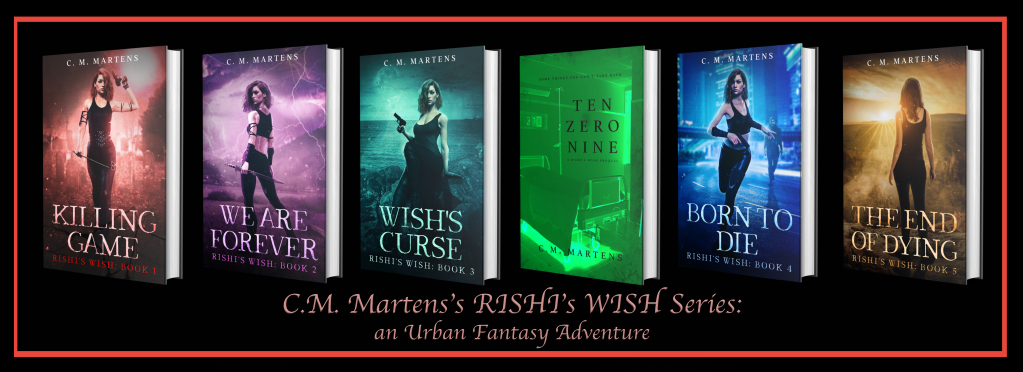
For example, Killing Game has just become permanently free on Amazon and is available for $0 across most platforms (including Nook). We Are Forever, the next book in the series, is only 99c, and about to be available on all platforms as well. Books 3 and 4 are locked into Amazon until April, but they are free to read on KU, or just $1.99 and $2.99 to buy. If you are one of the 30% not jacked into Amazon’s market, they’ll become available for you this summer.
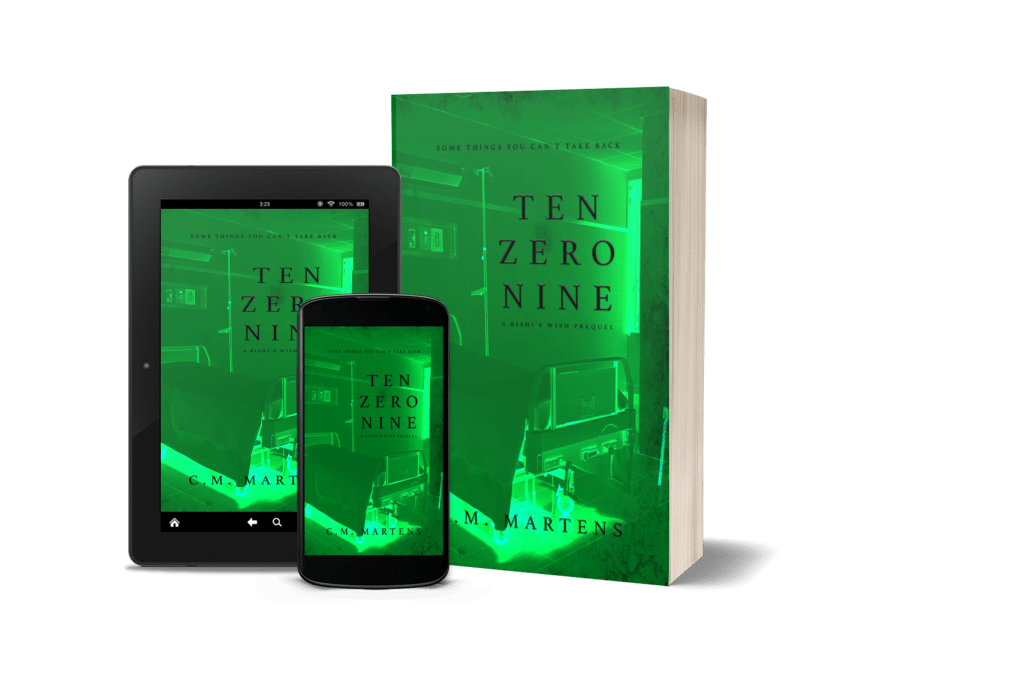
Want a creepier, more suspenseful read? Ten-Zero-Nine tells of Dee’s origins for just $1.99 on all platforms.
So, why wait? Adding books to our libraries only shows how prolific and better than everyone we are.
There’s a certain nervous expectation when going back to my favorite things. Do you know what I mean? Especially with books (and movies). I’ve found so much of how much I like something depends on my mood and mindset at the time. When I dive back in, there’s always a chance I was somehow out of my mind on that first interaction. Maybe this time I won’t feel the same. I could love it more. I could dislike it *gasp*
That’s why it’s even more exciting when something is just as fabulous the second and third time around. Here’s when you really know you have a favorite among favorites (a FAF? Can we make that a thing?). #FAF
The Sun Eater series is one of those that never disappoints. It’s the best of Dune and Name of the Wind, both books I read over and over. That I own them in physical form rather than ebooks proves my love. While I do love physical books, procuring space for them is a battle.
As with the first four (five?) times reading Empire of Silence, I was instantly taken in by the style. Again. I got actual goosebumps as I settled in to read. My first experience with Christopher Ruocchio was through an audiobook, and reading it brought to light details I missed in the distraction of carrying out tasks while I listened. My first ‘read’ had me tagging my favorite passages and quotes, of which there are many. I don’t usually do this, though I love collecting quotes through my Kindle’s highlighter. Here’s the bad thing about not having the e-version (though upon writing this, I’ve added them to my wishlist). I don’t have a system to capture favorite lines with physical books. I have only stopped to tab or text out my favorites with The Sun Eater.
A little more about Empire of Silence (I’m getting off point but I love this book)
When I think about Hadrian, away from reading, just as I feel about Kvothe (Name of the Wind), I envision an over-dramatic, arrogant personality skills come naturally. Then, I reflect on everything that happens to them and reconsider. “With great power comes great responsibility,” but also a fierce probability of heinous things happening in their lives and to them. Being ostracized by the people you love and, more horrendously, facing the consequences of your grand gestures and decisions are a couple of happenstances that come to mind. Both characters share a similar fate. Here is why both series keeps me coming back. This equality of dark and light. Of the good with the bad. Of planning a path to find it crumbling beneath them, only to see that this alternate journey was how it had to go to bring them where they could most help.
On this newest re-read of Empire of Silence, I wonder if Hadrian’s course would have always brought him to his final point. If he hadn’t run, if he’d followed the plan set by his father, would he still have found this operatic end? I think so, but only in an obsessive, over-analyzing mindset because I must remind myself it’s not REAL. There is little point in considering what-ifs and might-haves in our real lives, how futile to consider them in fiction? Still, I find it a fun thought experiment. And isn’t part of what makes these books so great the fact that we can have these discussions about them? Here is why they’re FAFs. And unlike many series, The Sun Eater gets better with each installment and most definitely with each re-read.
Bear with my first attempt in long years at a true essay. It devolved, very fast, into a bit of a ramble. I tried to reign it in…
Occasionally, I read a book that incites a need to comment rather than simply review. I write some reviews, usually when a book has a lower readership, and I want to help spread the word about it, but those are simple words from the gut; first impressions and feelings with little deep-diving. The Secret History is a book that has led me to be a bit more editorial. Not even the book, but rather the current popularity surrounding it. Yet again, it has me asking why certain books grab mass attention while others do not? What makes us love the books we love?
On Donna Tartt’s The Secret History
including a few comparisons that underline the question: why
I’m the kind of reader who likes to know the least amount about a book before I read it. How do I choose what to read, you ask? Sometimes, a single quote or great review—more likely, a terrible review—will compel me to pick up a book. A library recommendation, a pretty cover, or a great title. It’s so much about timing and things too abstract to quantify. I think that makes me a mood reader, but I’m not that concerned with labeling this part of my life to determine it.
Social Media’s algorithms currently love The Secret History. It crossed my feed enough times that I finally picked it up (B&N’s BOGO 50% helped with that, too). Within the first pages, I realized this was not a new book. Curious about why a book from 1992 is hitting charts, I put the book down to see why. I searched: ‘why is The Secret History still a favorite.’ One answer spoke of identifying with a feeling of isolation. Another spoke of our desire to belong to an elitist group, while a third remark spoke of friendship. There were a handful of other answers, but these stuck with me as I read Donna Tartt’s debut. As I read, I also found myself comparing it with The Goldfinch and Tomorrow, and Tomorrow, and Tomorrow (which I just read).
While I liked The Secret History, I did find it bloated. I found the term “friend” grossly inadequate, as few of the members of Julian’s class seemed more than forced acquaintances. Only Henry and Camilla’s pseudo-secret relationship was something more than a barely tolerated association. Richard even hears from each of them how the others aren’t that fond of him. Either explanation for this, whether truth or jealousy, begs the question of how well any of them were “friends.” That’s not to say each character wasn’t likable, at least as their part in the story is concerned. In reality, I wouldn’t have tolerated any of them as a friend of mine. They weren’t upstanding people, but rather interesting characters who propelled this drama. As this question of friendship was a highlighted point about the book’s likability, I beg the question: what about these “friends” drew readers in?
While an underlying sense of dread starts from the first page that keeps us intent on finding out how and what and who, it is the same magic Tartt uses in The Goldfinch with much more mastery. Of course, after writing this opinion, I went and read reviews and essays about The Goldfinch. Apparently, I have no idea what makes a good book. According to the critiques, The Goldfinch is about story, not character; therefore, it’s trash. Except, I liked it better. I thought Theo had more character than Richard, who we only know because he tells us. Richard says he’s a liar, though I can’t recall a point in dialogue when he does. He tells us he loves Camilla, though there is so little interaction on the page between them it seems impossible to be more than a boy’s crush (is that the point?). Julian is a supposed heavy influence, a father figure who barely exists on the page. Again, we only know how the “friends” feel about their teacher and mentor because we’re told. And while not necessarily a point against the book, the blurb implies some dark machinations at the hands of the Greek influence in their lives that is manipulatively overstated. Is it a point that creates circumstance? Yes. Is it part of the story? I didn’t think so.
This tension both books share from their onset is threaded onto every page of The Goldfinch. Theo is isolated, handling his stress alone, though in the same alcohol and drug-induced haze as the Hamden students of The Secret History, whose theme of separateness happens surrounded by peers. Stress that culminates in tangible events. Events I felt missing in The Secret History. But History takes place with a group, while Goldfinch is a story about a singular character. And we’re back to this point about “friends.” As I said, I would love to hear more about this distinction because I’m not sure my definition of “friend” coincides. Maybe, that’s the point. That the friends aren’t. That this ‘not’ is the relatable part.
Another book I feel lays bare this human condition in much clearer terms is Tomorrow, and Tomorrow, and Tomorrow. Both The Secret History and Tomorrow, and Tomorrow, and Tomorrow are books social media algorithms currently love. Both are full of this sense of isolation inside a group and lose a bit of what they are in the telling. Both are just too long. Both seem to drift off as if their subtly is so delicate, drawing out the theme has made it too damaged to let fade, so it must be severed or fall to pieces. I love that readers are reading and enjoying these books. I enjoyed them. I gave both The Secret History and Tomorrow, and Tomorrow, and Tomorrow four stars. It’s only in this over-analyzation that their flaws come through. I never meant to speak badly of them, only to ask why we love them over others. When I see mostly romance and YA saturating my feeds, I forget the average reader might actually read other books, too. It’s nice to see I’m not the only one with varying tastes.
I have long contemplated—and failed to answer—the question of what makes a book great, even for my own mind. Why The Secret History? Especially why this book and not others? We’re mad when the hero dies or suffers some long-standing PTSD in science fiction and dystopian YA, but when literature shows a layer of darkness inherent in life, we call that insightful. Is it a matter of staying in one’s lane? A love story without a happily-ever-after can not be shelved romance because it breaks a pact more sacred than wedding vows. Expectation, is that the difference? If a novel is exactly what we are told it will be, it becomes popular? And is that the same thing as being good?
This wasn’t meant to be a comparison. It was meant to be a meandering commentary on why we love the books we do; why some books get press while others of similar quality, or better, do not. There really is no answer, not that I can give, but I will continue to ramble on about it.
It definitely helps to know someone’s tastes when following recommendations, so I thought I’d put up some of my favorites. It was way harder than I thought to narrow this down. There are way more books on this page than I meant there to be…
Top 10
In no particular order:
The Name of the Wind (Book 1 of the Kingkiller Chronicles) by Patrick Rothfuss
Dune by Frank Herbert
Hero (book 3 of Epic Saga) by Lee Stephen
Empire of Silence by Christopher Ruocchio
Ender’s Game by Orson Scott Card
Song of Achilles by Madeline Miller
Empire of the Vampire by Jay Kristoff
Too Like the Lightning by Ada Palmer
The Rage of Dragons by Evan Winter
Blood Song (Book 1 of the Raven’s Shadow Series) by Anthony Ryan
Almost made the top list
House of Leaves by Mark Z. Danielewski
Ready Player One by Ernest Cline
Evo Nation Series by K. J. Chapman
The Starless Sea by Erin Morgenstern
Echo Series by Kent Wayne
14 by Peter Cline
In Her Name Series by Michael Hicks (especially book 5)
The Host by Stephanie Meyer
The Legion & the Lioness by Robert D. Armstrong
Heretics of Dune by Frank Herbert
The Lightbringer Series by Brent Weeks
The Giver by Lois Lowry
Battlefield Earth by L. Ron Hubbard
Hyperion by Dan Simmons
Wyvern by A. A. Attanasio
The Dragonian Series paired with the Moonbeam Series by Adrienne Woods
Stain by A.G. Howard
Red Rising by Pierce Brown
Huge fan of:
Mercy Thompson Series by Patricia Briggs
First seven books in the Anita Blake Series by Laurell K. Hamilton
Anne Rice
Science Fiction
The Arthurian Saga by Mary Stewart
The Fever Series by Karen Marie Moning
The rest of the Dune books, including everything his son wrote
A Song of Ice and Fire by George R. R. Martin (though I almost threw the last one)
Geodyssey by Piers Anthony
The Hunger Games by Suzanne Collins
Nighthawk by Marie Frances
Supernaturals: A Ghost Story by David Lynn Goleman
Xenogenesis Series by Octavia Butler
S. by J.J. Abrams
Invisible Life of Addie LaRue by V.E. Schwab
To Sleep in a Sea of Stars by Christopher Paolini
I’m not a fan of:
…Brandon Sanderson books. I typically find them dull, though the concepts are always fantastic. I think I’ve given 3 stars to every book of his I’ve read, except the first Mistborn book which was a 4 star. So, I guess it’s not that I’m not a fan, I just don’t love him like everyone else I know…
…Stephen King. Not even The Dark Tower Series. So many words for no reason, though I did enjoy Misery and Pet Cemetary.
…The Dresden Files by Jim Butcher. Sorry, Scott. I just don’t *shrug* Maybe because I’d already read Anita Blake and just couldn’t do another supernatural cop-mystery-who-done-it series? Maybe I’m just sexist when it comes to this kind of book…
Books I re-read over & over
Dune
Enemies by Tijan
Made of Steel Series by Ivy Smoak
Fever Series by Karen Marie Moning
Stain by A.G. Howard
The Burning Series by Evan Winter
Your Thoughts
I’d love to hear your comments on any of the above 🙂
TEN-ZERO-NINE is the psychological thriller sequel to my Rishi’s Wish series. A short, fast-paced read that will leave you biting your nails and afraid to turn the lights off. Get it here:
All Steve wanted was to find the balls to tell the girl of his dreams how he felt.
And he finally had. Today was that day. A day engineered with no distractions. A day for just the two of them. No roommates. No cowardice. No second-guessing that the friendship they’d built over the last year wasn’t more. Today was the day his hellish existence would move into the light.
Snatched away by four simple words, Steve’s day turns dark. From one second to the next, taking his future in his hands turns to a speeding train bearing down on him.
Each day more torturous than the last, he’s forced to watch his love slumber through a dangerous experimental procedure. A procedure that has never worked. A procedure that turns her from his friend into subject 10-0-9.
When she wakes, when she finally comes to, the first to survive, Steve wants to take it all back. The nightmare he’d been living was nothing compared to this.



 Author C.M. Martens